

• Virtual executive assistant services work best when leaders set clear expectations and define what success looks like.
• Remote workers are 13% more productive than in-office workers, according to Stanford University, which enhances the impact of strong onboarding.
• SOPs are one of the fastest ways to create consistency, reduce errors, and shorten training for future hires.
• Daily communication rhythms help assistants grow faster and prevent misunderstandings before they surface.
• Inclusion, recognition, and structure lead to long-term retention and stronger partnerships with remote assistants.
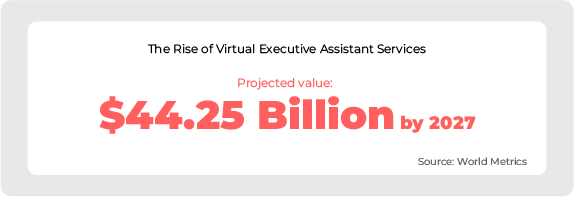
Virtual executive assistant services are growing faster than ever, and for good reason. Remote workers have proven to be 13% more productive than their in-office counterparts, according to Stanford University. Yet despite this advantage, many small business owners never unlock the full potential of the support they hire.
Over the past few years, we’ve tested virtual executive assistant success patterns with 101 clients across 25 different industries. The data is clear: hiring an assistant is easy. Getting results requires structure. The biggest performance differences didn’t come from the assistants, they came from how leaders set expectations, communicated, and built the working relationship.
Virtual executive assistants can drastically reduce your workload, streamline your operations, and give you back meaningful hours each week. When clarity, communication, documentation, and training come together, your remote assistant harmonizes with your goals and creates the conditions for long-term momentum.
One of the biggest predictors of success across our testing with 101 clients in 25 industries was surprisingly simple: leaders who began with a clear job description had smoother onboarding, faster productivity, and fewer early frustrations. Most business owners know they’re overwhelmed, but haven’t actually written down what they want to delegate. Without clarity, even the most skilled assistant will struggle to meet expectations.
A strong job description outlines your core responsibilities, how long these tasks should take, and what success looks like. It also includes “secondary tasks” work your assistant can take on during slower periods. This not only increases ROI, but it also keeps your assistant engaged and prevents the quiet disengagement that often leads to turnover.
When your needs are clearly defined, matching becomes far more precise. You’re not just hiring “help”, you’re hiring the right person for your workflow, your pace, and your communication style. And that alignment is what makes long-term partnerships possible.
💡Pro tip: During your interview, ask: “What have you done in the past when you ran out of tasks or had slower periods during office hours?” Experienced assistants know how to identify new areas to support once they understand the role.
Even with a strong hiring process, virtual executive assistants don’t come pre-loaded with your workflows. In our experience working with leaders across 25 industries, the partnerships that thrive all invested in one thing: intentional onboarding. Remote training requires clarity, structure, and more proactive communication than hiring someone in person.
Use this checklist to set your assistant up for success:
What Your Assistant Needs on Day One
• A responsibilities overview
What they own daily, weekly, and monthly.
• A clear communication plan
How to ask questions, how fast you expect responses, and which channels to use.
• Access to every tool and login
Calendar, email, CRM, project boards, files, shared drives.
• A full walkthrough of your workflow
Show how you make decisions, not just what to do.
• Examples of past work
Templates, screenshots, drafts: context builds confidence.
• BETTER: A 30-day training schedule
Keeps progress on track and prevents confusion or assumptions.
What They Need in Week One
• Daily check-ins + daily checkouts
Alignment matters more than long meetings.
• Recorded training sessions
For reference, consistency, and future SOPs.
• Early feedback
Small corrections now prevent big mistakes later.
• BETTER: Quick access to you (or a supervisor)
Remote assistants can’t tap you on the shoulder.
What Makes Remote Onboarding Work
• Show your process visually (screenshare beats paragraphs)
• Explain not just the task, but the goal behind it
• Let your assistant shadow live tasks before taking over
• Give them permission to ask “why,” so they learn your logic
💡 Pro tip: Recording onboarding calls with AI tools like Fathom instantly turns any training session into a searchable SOP. This small habit speeds up learning, reduces repeated explanations, and drastically shortens the ramp-up time for future hires.
There are many ways to create an SOP, but here’s the truth: most small business owners don’t have them. Tasks live in their head, processes change on the fly, and onboarding becomes a long relay of repeated explanations. Instead of seeing this as a weakness, it’s one of the strongest reasons to hire a virtual executive assistant in the first place.
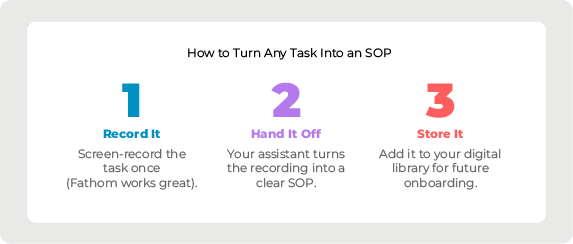
Your assistant can build your SOPs as they learn your workflow. The easiest method is simple: record your screen while you perform the task once. If you use an AI tool like Fathom, the software will automatically generate timestamps, summaries, and transcripts. From there, your assistant can transform the recording into a clean SOP: complete with screenshots, step-by-step instructions, links, and templates.
Over time, these recordings turn into a fully built digital library for future hires. You never have to repeat onboarding from scratch, and your assistant becomes the architect of your internal operations. This level of organization is what separates businesses that scale smoothly with small teams from businesses that stay stuck reacting to daily fires.
SOPs don’t need to be perfect. They just need to exist. And once your assistant owns the documentation process, consistency becomes automatic instead of effortful.
Virtual executive assistants are smart, capable, and highly trained, but they’re not your COO, founder, or strategic partner. They excel when given clear direction, structured responsibilities, and defined outcomes. When leaders set expectations realistically, assistants perform at their highest level and feel confident taking ownership of recurring tasks.
Remember: an assistant’s role is execution. They help you move faster, stay organized, and maintain consistency. Your role as the leader is to provide context, and review work with the same level of supervision you’d give any new hire. When those boundaries are clear, the workflow becomes smoother, and your assistant becomes more effective. Eventually, they’ll be able to set priorities for you, but you have to give every process the due time.
The assistants who thrive long-term are the ones whose leaders communicate decisions, explain the “why”.
In every successful remote partnership we’ve observed, communication was the deciding factor. Not skills. Not tools. Communication. Virtual executive assistants don’t have the advantage of hallway chats or quick desk check-ins—they rely entirely on what you say, how often you say it, and how clearly expectations are shared.
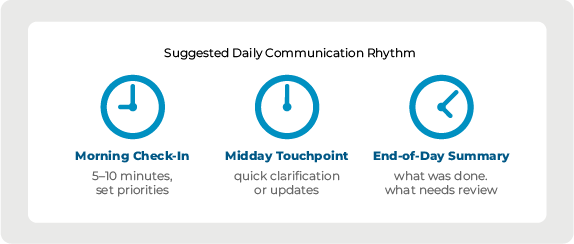
Short, consistent communication beats long, infrequent meetings. Daily check-ins and end-of-day summaries keep the workflow aligned and prevent small uncertainties from becoming big mistakes. A five-minute huddle often produces more clarity than a 45-minute meeting once a week, and it’s where many clients naturally uncover new tasks their assistant can take on.
The more predictable your communication rhythm, the faster your assistant grows.